Some particles cannot be handled by chemistry alone. Those pressed onto the surface or half-buried in a film have to be taken off by physical force. As the final article in this series, this one covers the physical cleaning methods and the water and air that everything else presumes. And it closes a journey of twenty articles.
Three physical methods
1. Brush — the misunderstood method
The name invites a misconception. Brush cleaning is not the bristles scraping contamination off. What actually happens is that a thin water film forms between brush and contaminant, and the drag generated as the rotating brush pulls that film along removes the particle.
This is not a metaphor but a modelled result. A study of how nanoparticles come off in brush scrubbing identifies the dominant removal forces as the elastic force from deformation of the brush asperity and the hydrodynamic drag force (Huang, Guo, Lu et al., Appl. Surf. Sci. 257, 3055, 2011). The same group later modelled the process as three removal modes — rolling, sliding, and lifting (Huang, Guo, Lu et al., Wear 273, 105, 2011).
The principle matters because it lets you remove particles without scratching the surface. Early brushes used hard nylon, which left scratches, so today a soft, compliant porous material is standard. Designs that reduce scratching by making the outer surface smooth and nubless have also been patented (US 7,185,384 B2).
2. Megasonic — shaking with sound
A non-contact method that drives acoustic waves through the liquid to shake particles loose. The principle is the same as familiar ultrasonic cleaning, but the frequency is far higher.
The definition is clear enough: "transducers produce acoustic waves at frequencies (typically 0.8 to 2 MHz) higher than those of ultrasonic cleaning (20 to 200 kHz)", and because of this high frequency it produces "less damaging cavitation" (Megasonic cleaning).
Why raise the frequency? Because at low frequency the cavitation — the birth and collapse of bubbles in the liquid — is violent enough to destroy patterns. Raising the frequency makes the bubbles smaller and gentler, so fine structures survive while particles are still shaken free. The trade is electrostatic problems, and cleaning power that sometimes falls short of the high-pressure jet we are about to meet.
3. High-pressure jet and two-fluid — striking with force
Water is sprayed at pressures from tens to well over a hundred bar. For scale, a car-wash pressure washer runs at roughly 80 bar — so this is a jet of comparable or greater strength, aimed with precision.
Instead of water alone, the two-fluid approach sprays a gas such as nitrogen together with water to form fine droplets. Because individual droplets strike the surface, it delivers far greater local impact for the same flow rate. Work continues on finding conditions under which this method removes nanoparticles without damaging patterns (Teng, Cui, He et al., CSTIC 2016).
It is considered the most effective way to remove particles already stuck fast or half-embedded in a film. The side effects are correspondingly large — fast-flowing water generates static electricity. Countermeasures such as dissolving carbon dioxide in the water to give it slight conductivity are used alongside.
What the frequency decides — the arithmetic of megasonics
"Higher frequency is gentler" can be checked by calculation. A bubble in liquid has a natural frequency, given by a relation set out in 1933: the resonance frequency of a bubble is inversely proportional to its radius (Minnaert, Philosophical Magazine 16, 235, 1933).
Resonant radius R = √(3γP₀ ÷ ρ) ÷ (2π f) — γ: heat capacity ratio 1.4, P₀: atmospheric pressure, ρ: density of water
Computing the acoustic boundary layer thickness √(2ν÷ω) and the wavelength in water c÷f alongside it shows at a glance what the choice of frequency governs.
| Frequency | Resonant bubble radius | Acoustic boundary layer | Wavelength in water | Character |
|---|---|---|---|---|
| 40 kHz (ultrasonic) | 82 µm | 2.82 µm | 37.5 mm | Large bubbles, violent collapse — destroys patterns |
| 200 kHz | 16.4 µm | 1.26 µm | 7.5 mm | Intermediate |
| 0.8 MHz (megasonic) | 4.1 µm | 0.63 µm | 1.9 mm | Gentle cavitation |
| 2 MHz (megasonic) | 1.6 µm | 0.40 µm | 0.75 mm | Gentlest — but less force reaches small particles |
The second column is what "gentle" actually means. Going from 40 kHz to 1 MHz shrinks the resonant bubble radius by a factor of 25, and its volume by roughly fifteen thousand. If the energy released when a bubble collapses scales with its volume, the same event has been made four orders of magnitude smaller. That is why megasonics leaves patterns standing.
The third column names the price. Near a vibrating surface there is an acoustic boundary layer in which the flow velocity falls almost to zero; a particle smaller than this layer sits submerged inside it and never feels the full drag. At 1 MHz that thickness is about 0.56 µm, so particles of a few hundred nanometres and below are, in principle, hard to remove by flow alone. Megasonic removal of nanoparticles therefore leans heavily on the local action of cavitation bubbles, and multi-frequency designs that combine a lower frequency for cleaning power with a higher one for damage avoidance have been proposed (Kim, Lee, Lim et al., IEEE Trans. Semicond. Manuf. 28, 521, 2015).
The fourth column is a question of uniformity. With a wavelength of only a few millimetres, the sound field is dense with nodes and antinodes. Leave the substrate still and some places get scrubbed hard while others are never touched at all. That is why megasonic equipment always moves either the substrate or the nozzle.
How small can each method go, and where does it break things?
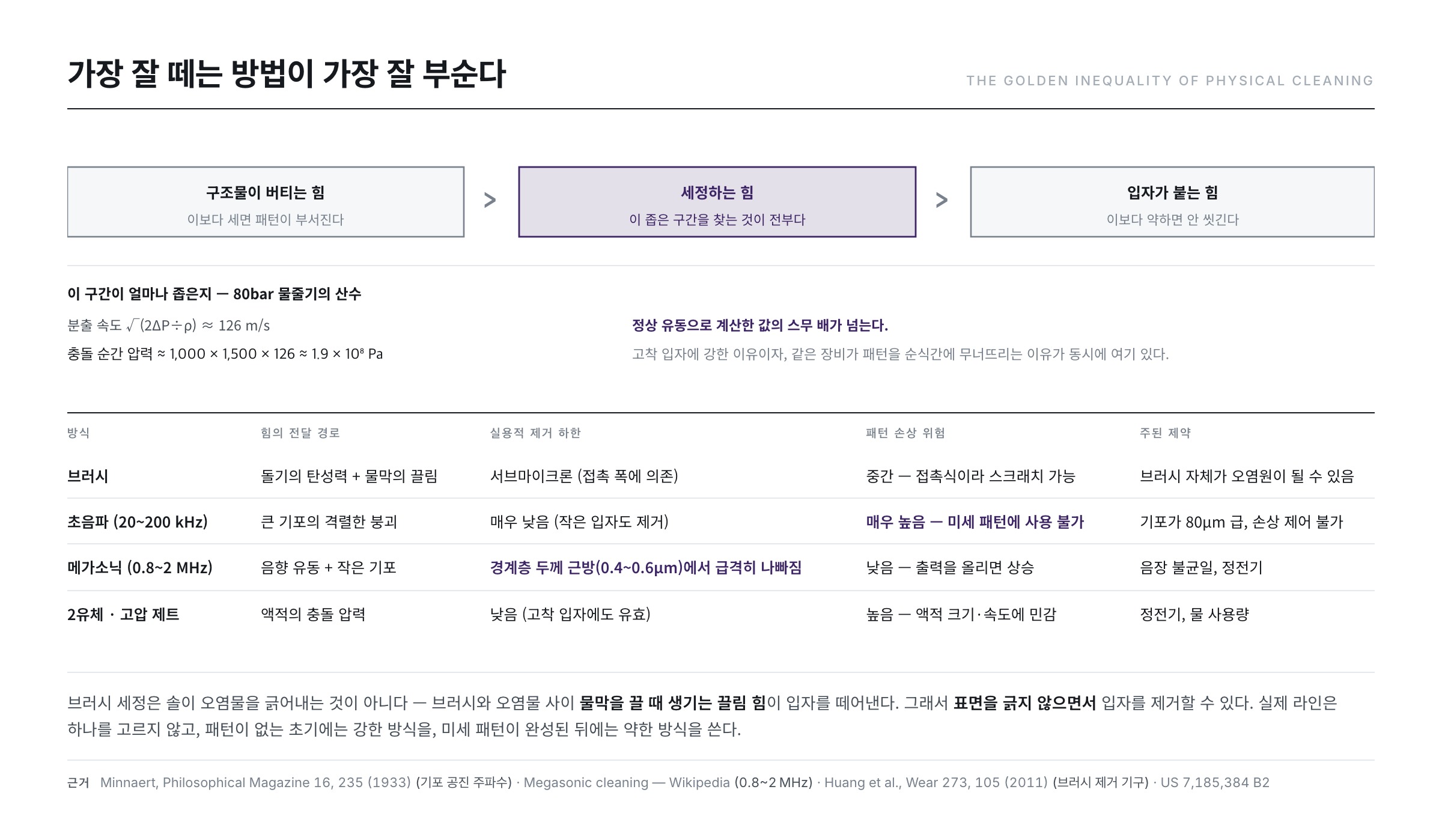
Putting four methods in one table reveals the structure of the choice. The lower size limit of each is set by the physical channel through which it delivers force to the particle.
| Method | Force pathway | Practical lower size limit | Pattern damage risk | Main constraint |
|---|---|---|---|---|
| Brush | Asperity elasticity plus drag of the water film | Sub-micron, depending on contact width | Moderate — contact, so scratching is possible | The brush itself can become a contamination source |
| Ultrasonic (20–200 kHz) | Violent collapse of large bubbles | Very low — even small particles come off | Very high — unusable on fine patterns | Bubbles of order 80 µm; damage cannot be controlled |
| Megasonic (0.8–2 MHz) | Acoustic streaming plus small bubbles | Degrades sharply near the boundary layer thickness (0.4–0.6 µm) | Low — rises with power | Non-uniform sound field, static electricity |
| Two-fluid and high-pressure jet | Droplet impact pressure | Low — works even on stuck particles | High — sensitive to droplet size and velocity | Static electricity, water consumption |
What the table compresses is the dilemma of physical cleaning. The method that removes best is the one that breaks best. So a real line does not pick one; it places strong methods early, when there are no patterns, and weak ones once fine patterns exist, swapping methods according to the process stage. Approaches that avoid megasonics entirely and rely on chemistry and flow alone have also been proposed (Kim, Cho, Kim et al., IEEE Trans. Semicond. Manuf. 17, 261, 2004).
The golden rule of physical cleaning
Physical cleaning has one inequality that must never be violated.
Strength of the structure > cleaning force > particle adhesion force
If the cleaning force is weaker than the adhesion, nothing is removed; if it exceeds the strength of the structure, the pattern breaks. Finding the narrow band between the two is the whole of physical cleaning process design.
How narrow that band is becomes tangible when you compute a droplet impact. Water driven at 80 bar leaves the nozzle at √(2ΔP÷ρ), or about 126 m/s. The stagnation pressure this jet exerts on the surface is again of order 80 bar — but at the instant a droplet strikes the story is different. Immediately after impact the interior of the droplet is still uncompressed, and the pressure spikes to ρ·c·v; inserting the speed of sound in water, 1,500 m/s, gives about 1,900 bar.
Impact pressure ≈ water density × speed of sound in water × droplet velocity = 1,000 × 1,500 × 126 ≈ 1.9 × 10⁸ Pa
That is more than twenty times the steady-flow value. Here lies both the reason high-pressure jets and two-fluid cleaning are so effective against stuck particles, and the reason the same equipment flattens a pattern in an instant. It is also why, in these methods, droplet size and velocity distribution are managed more carefully than pressure itself.
And this inequality changes from step to step. On a flat substrate early on you can strike hard; once fine patterns are complete, the same condition is destructive. Cleaning recipes are therefore set differently for each process stage.
When the rinse water is dirty — ultrapure water
An obvious fact that is easy to miss: if the rinse water is contaminated, cleaning becomes a contamination step. That is why semiconductor and display lines make their own water.
The headline metric for ultrapure water (UPW) is resistivity. Ions dissolved in water conduct electricity, so higher resistance means higher purity. The theoretical limit is about 18.18 MΩ·cm at 25℃, and lines manage against that baseline (Ultrapure water).
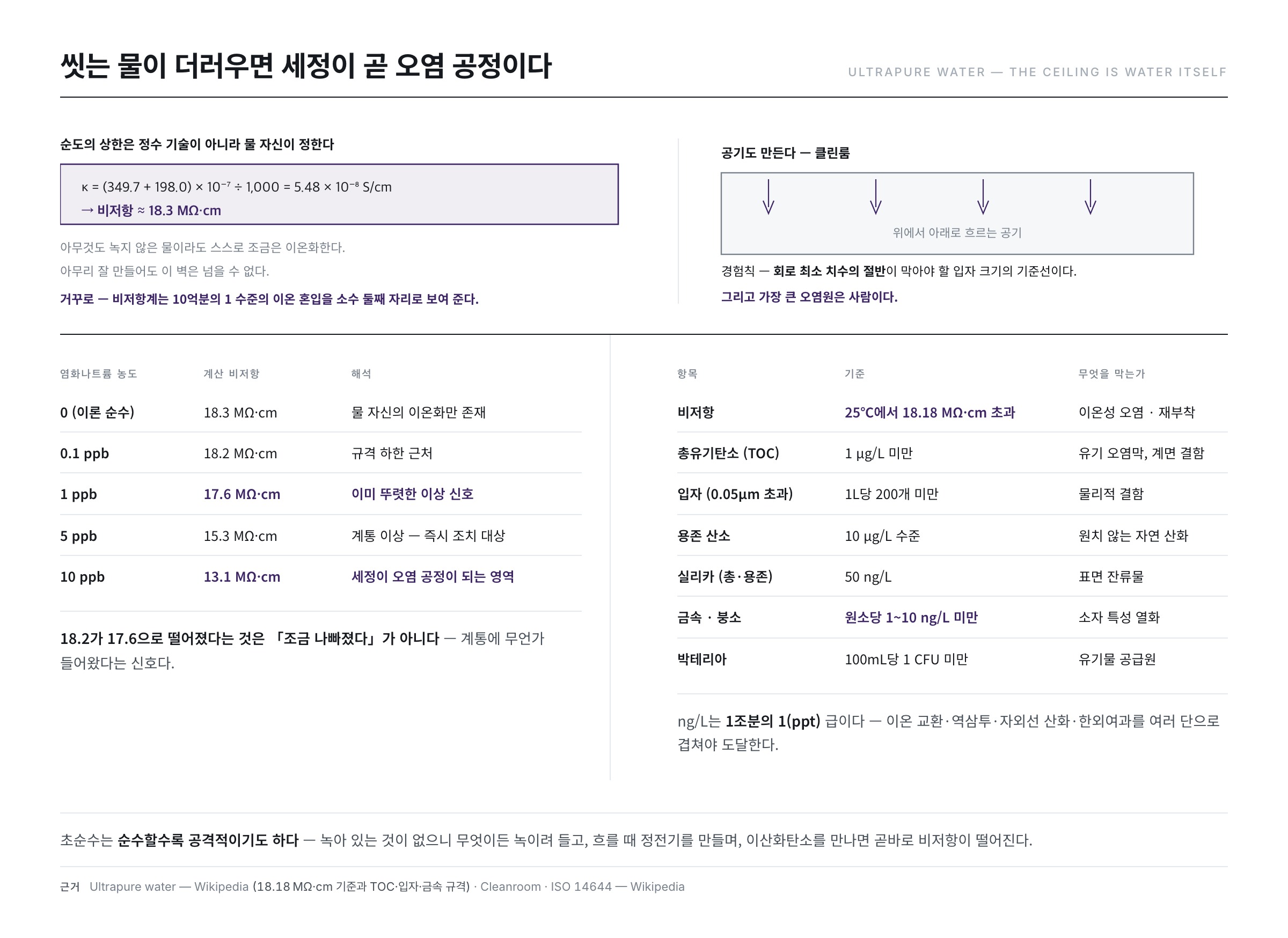
Where the number 18.18 comes from can be worked out directly, because even perfectly pure water ionises itself a little. At 25℃ the ion product of water is 10⁻¹⁴, so hydrogen and hydroxide ions are each at 10⁻⁷ mol/L; multiplying by their molar conductivities (about 349.7 and 198.0 S·cm²/mol) and summing gives the conductivity.
κ = (349.7 + 198.0) × 10⁻⁷ ÷ 1,000 = 5.48 × 10⁻⁸ S/cm → resistivity = 1 ÷ κ ≈ 18.3 MΩ·cm
The result differs from the quoted 18.18 only after the decimal point. The ceiling on water purity is set not by purification technology but by water's own self-ionisation. However well you make it, that wall cannot be crossed.
Conversely, what a small drop in resistivity means can also be computed. Below is the result of assuming a trace of salt has dissolved and running the same calculation.
| Sodium chloride | Molarity | Calculated resistivity | Interpretation |
|---|---|---|---|
| 0 (theoretical pure) | 0 | 18.3 MΩ·cm | Only water's own ionisation |
| 0.1 ppb | 1.7 × 10⁻⁹ mol/L | 18.2 MΩ·cm | Near the specification floor |
| 1 ppb | 1.7 × 10⁻⁸ mol/L | 17.6 MΩ·cm | Already a clear anomaly signal |
| 5 ppb | 8.6 × 10⁻⁸ mol/L | 15.3 MΩ·cm | System fault — act immediately |
| 10 ppb | 1.7 × 10⁻⁷ mol/L | 13.1 MΩ·cm | The regime where cleaning contaminates |
What the table shows is how sensitive a watchdog the resistivity meter is. Ionic ingress at the parts-per-billion level shows up in the second decimal place. A fall from 18.2 to 17.6 does not mean "slightly worse" — it means ten times as many ions.
Resistivity is not the only controlled item. Collecting the representative criteria gives the following (Ultrapure water).
| Item | Criterion | What it prevents |
|---|---|---|
| Resistivity | above 18.18 MΩ·cm at 25℃ | Ionic contamination, re-deposition |
| Total organic carbon (TOC) | below 1 µg/L | Organic films, interface defects |
| Particles above 0.05 µm | fewer than 200 per litre | Physical defects |
| Dissolved oxygen | of order 10 µg/L | Unwanted native oxidation |
| Silica (total and dissolved) | 50 ng/L | Surface residue |
| Metals and boron | below 1–10 ng/L per element | Device degradation |
| Bacteria | below 1 CFU per 100 mL | A source of organics |
The units alone tell you what kind of process this is. ng/L is parts per trillion. Reaching that purity requires ion exchange, reverse osmosis, ultraviolet oxidation, and ultrafiltration stacked in multiple stages, and finding the combination that satisfies resistivity and TOC at once is a research subject in itself (Zhao, Bai, Liu et al., Process Saf. Environ. Prot. 126, 232, 2019). It deserves the name the cleanest water in the world.
Air is manufactured too — the cleanroom
Airborne dust is the same problem, so processing happens in a cleanroom. A cleanroom's class is defined by the number of particles above a given size in a unit volume of air.
Under the old US standard, Class 100 meant "no more than 100 particles of 0.5 µm or larger per cubic foot", which corresponds roughly to ISO Class 5 in the current international standard (ISO 14644-1). Lower numbers are cleaner, and the photolithography and cleaning bays run at the strictest classes (ISO 14644).
There is an old rule of thumb for "how small a particle must be stopped": half the minimum feature size. Material describing ultrapure water specifications invokes the same principle, noting that for a 40 nm device every particle larger than 20 nm must be filtered out (Ultrapure water). Backplane dimensions are far larger than those of leading-edge silicon, but the principle is identical — the criterion is not an absolute size but a ratio to the size of what you are building. Every generational step up in resolution therefore automatically raises the bar for cleaning and cleanliness as well.
The interesting part is that the largest contamination source is people. Humans continuously shed skin flakes and fine fibres. Hence the mandatory gowning and air showers — and hence the fact that automating a process tends to improve quality (Cleanroom).
What the line watches — three control points
- Particle count and size distribution — comparing before and after gives removal efficiency. If particles in one particular size band survive, that is a signal that the method matched to that size is missing. Recalling the boundary layer calculation above, a line running megasonics alone that stubbornly fails below about 0.5 µm may not have an equipment fault at all, but a result of physics.
- Substrate damage — scratches, missing pattern, silicon etch loss. The inseparable companion to any increase in cleaning strength.
- Utility status — ultrapure water resistivity and TOC, cleanroom particle counts, chemical concentrations. However good the cleaning tool, none of it matters if these collapse.
Common misconceptions
"Can't we just use an ultrasonic cleaner?" — A different frequency makes it a different machine. As the table showed, resonant bubbles in the 40 kHz band have radii of order 80 µm, far larger than a fine pattern. When such a bubble collapses beside a structure the result is not cleaning but breakage. Frequency is not an intensity knob; it is the switch that decides whether damage happens.
"Physical cleaning is stronger than chemical cleaning." — They simply point in different directions. Physical force cannot reach inside the contact area, and chemistry cannot unbind a contact that has set. Real cleaning is always a combination in which chemistry weakens the bond and physics removes the particle. Running megasonics during the alkaline clean of the previous article is the classic example.
"Water only has to be clean." — Ultrapure water is also more aggressive the purer it is. With nothing dissolved in it, it tries to dissolve whatever it touches, generates static as it flows, and loses resistivity the moment it meets carbon dioxide. Ultrapure water is therefore not a material you make and store but a facility you keep circulating and managing.
Closing twenty articles
In article 1 we magnified a screen and looked at the sub-pixel grid. Then we set out on the journey of building the circuit layer that controls that grid — the backplane.
Looking back, the road went like this. Coat a liquid on glass to make the substrate (articles 2 and 3), drive out the hydrogen to prepare for the laser (4 and 5), melt and freeze for nanoseconds to grow crystals (6 and 7), implant impurities to inscribe polarity (8), and on the stage of vacuum and plasma (9) stack metals and insulators (10 and 11), draw circuits with light (12 and 13), cut to the pattern (14 to 16), strip the mask (17), and wash clean again (18 to 20) to prepare for the next layer — a repetition of that cycle.
A few principles kept reappearing on this journey.
- Everything happens beneath a ceiling of temperature — the temperature glass cannot withstand shaped the entire form of LTPS as a technology.
- The result of one step shows up several steps later — bow from annealing appeared as exposure misalignment, particles in the PI as explosions during ELA, hard bake temperature as an etch profile.
- Like hydrogen, the same thing is sometimes the enemy and sometimes the ally — there was a time to remove it and a time to put it back.
- The biggest fight is not performance but uniformity — making millions of things identical is the essence of this industry.
The last three articles add one more. What governs a process is usually not the largest force but the smallest scale. The calculation that gravity on a 1 µm particle is a millionth of its adhesion (article 18), the choice to dilute HF a hundredfold just to buy 15 seconds (19), the design that raises frequency 25-fold to shrink a bubble fifteen-thousandfold (20) — all three were telling the same story. The smaller things get, the more our intuition fails, and only calculation remains.
Thank you for coming this far. The next time you wake your phone screen, if the fact that millions of transistors behind it are each passing exactly the right current feels a little different — then this series has done its job.
References
- Minnaert, "On musical air-bubbles and the sounds of running water", Philosophical Magazine 16, 235 (1933) : the classic relation making bubble resonance frequency inversely proportional to radius
- Kim, Lee, Lim et al., "Dual-Frequency Megasonic Waveguide for Nano-Pattern Cleaning", IEEE Trans. Semicond. Manuf. 28, 521 (2015) : splitting cleaning power and damage avoidance across two frequencies
- Kim, Cho, Kim et al., "Megasonic Free Single Wafer Cleaning Using Ozone Jet Without Pattern Damage", IEEE Trans. Semicond. Manuf. 17, 261 (2004) : reducing both pattern damage and substrate etching without megasonics
- Huang, Guo, Lu et al., "Mechanisms for nano particle removal in brush scrubber cleaning", Appl. Surf. Sci. 257, 3055 (2011) : the role of elastic and hydrodynamic drag forces in brush cleaning
- Huang, Guo, Lu et al., "Modeling of particle removal processes in brush scrubber cleaning", Wear 273, 105 (2011) : the rolling, sliding, and lifting removal modes
- Teng, Cui, He et al., "Damage free removal of nano-particles with dual-fluid spray nozzle cleaning", CSTIC (2016) : conditions for removing nanoparticles by two-fluid spray without pattern damage
- Zhao, Bai, Liu et al., "Process optimization for producing ultrapure water with high resistivity and low total organic carbon", Process Saf. Environ. Prot. 126, 232 (2019) : purification train design meeting resistivity and TOC together
- US 7,185,384 B2 — Wafer cleaning brush : reducing scratches with a smooth, nubless brush surface
- Megasonic cleaning — Wikipedia : the megasonic band (0.8–2 MHz) versus ultrasonic (20–200 kHz), and less damaging cavitation
- Ultrapure water — Wikipedia : the 18.18 MΩ·cm baseline, TOC, particle and metal specifications, and the filtration criterion relative to feature size
- Cleanroom — Wikipedia · ISO 14644 — Wikipedia : cleanroom classification and contamination source control