The speaker at the next desk, the store announcement, the overlapping audio guides in an exhibition hall — every day we are exposed to sound we did not ask for. We need sound; we do not need noise. There is a technology that tackles this old dilemma head-on: the directional speaker.
This is the first article in the series "The Science of Directional Speakers." Building on the physics of ultrasound and the parametric acoustic array, we will work through — from the ground up — the technology that lets us aim sound the way we aim light.
An ordinary speaker is a light bulb
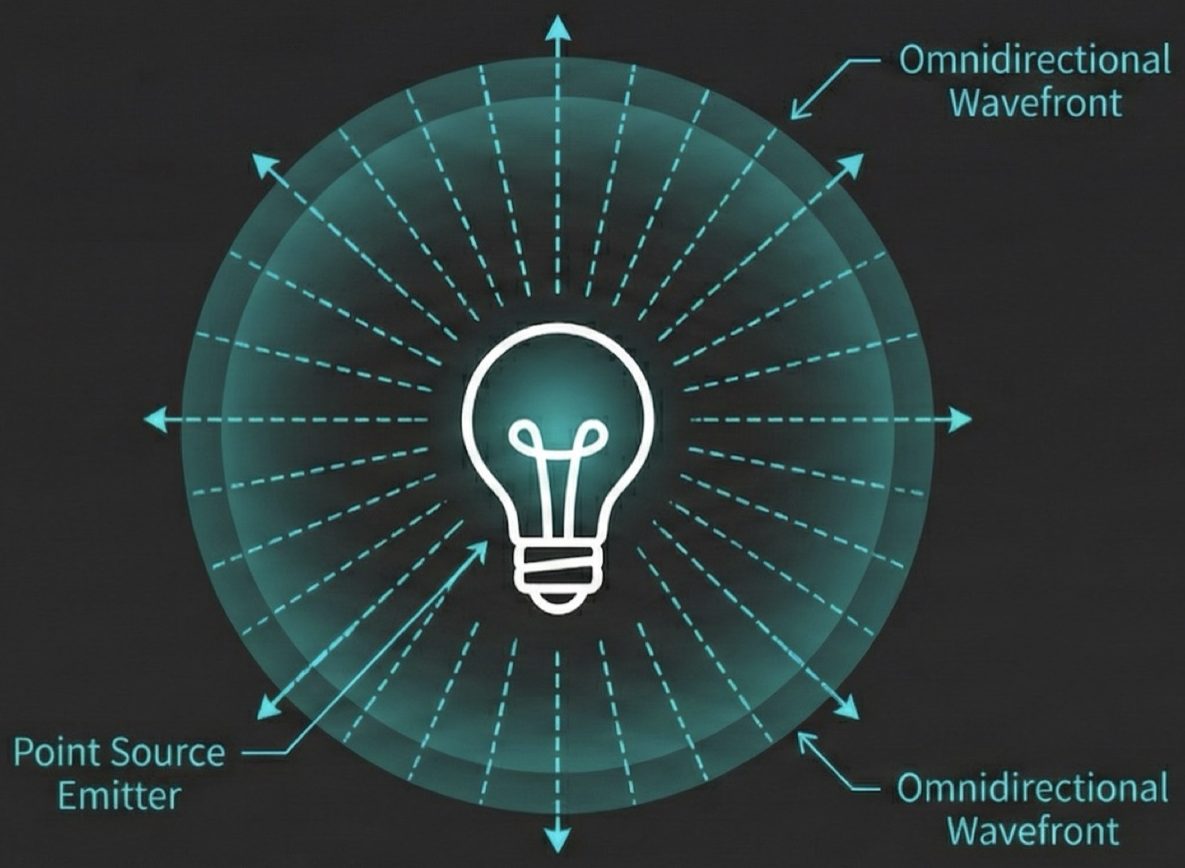
If we compare an ordinary speaker to light, it is a bulb. Just as a bulb scatters light in every direction, an ordinary speaker radiates acoustic energy all around it. In acoustics this is called a point source.
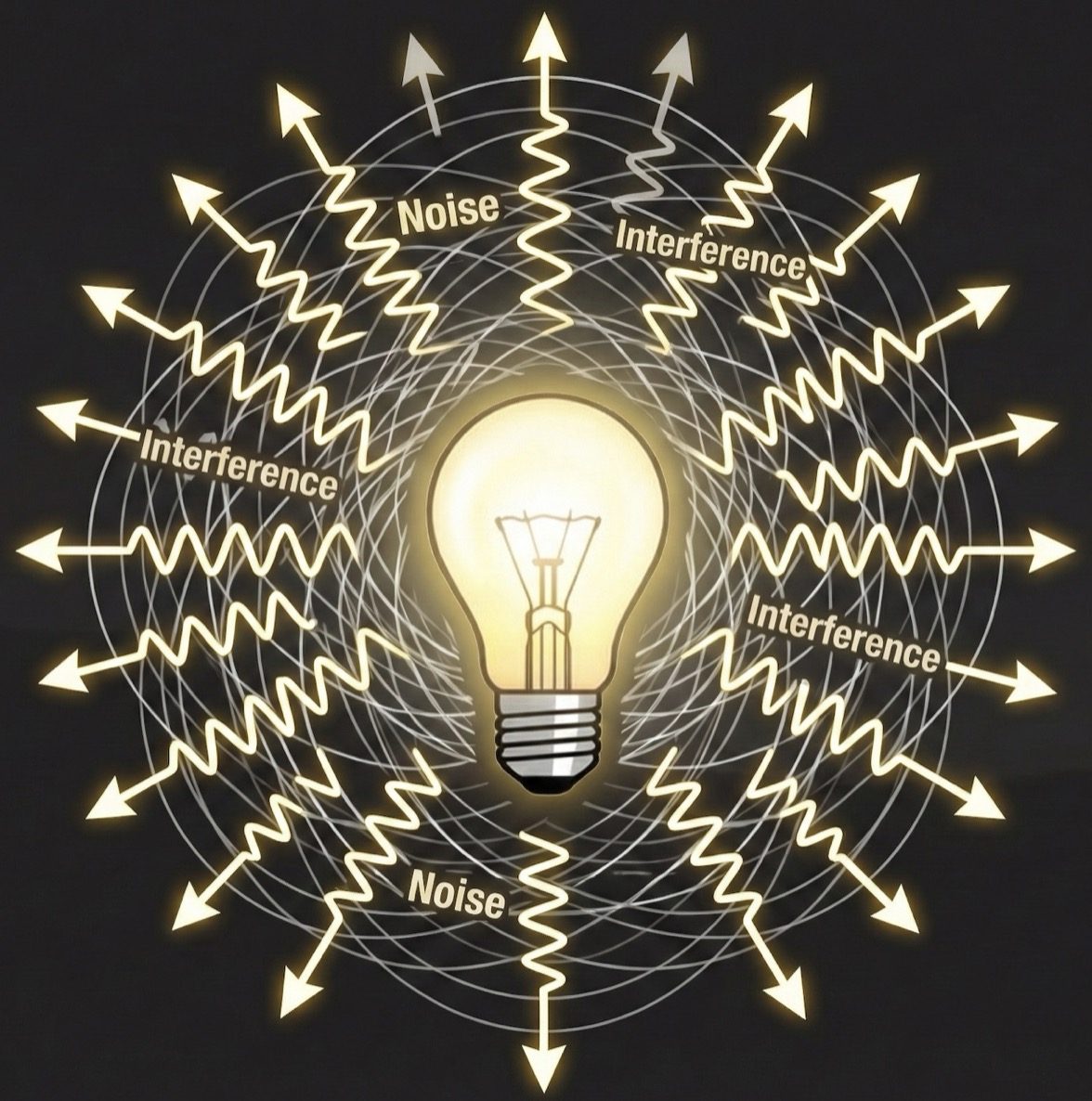
The fate of a point source is the inverse-square law. Energy spreads evenly over a sphere, so doubling the distance scatters the same energy over four times the area. Sound pressure halves; in decibels, the level drops 6 dB for every doubling of distance. A sound heard at 80 dB one metre from the speaker becomes 74 dB at 2 m, 68 dB at 4 m and 62 dB at 8 m. To make it audible to someone far away, you must make it punishingly loud for the person standing close.
When energy goes everywhere, three problems follow.
- Noise pollution — the sound reaches spaces where it is not wanted, and to the people there it is simply noise.
- Loss of privacy — an announcement or alert meant only for you is heard by everyone.
- Poor delivery — sound pressure decays sharply with distance, so the person who actually needs to hear it receives a blurred signal.
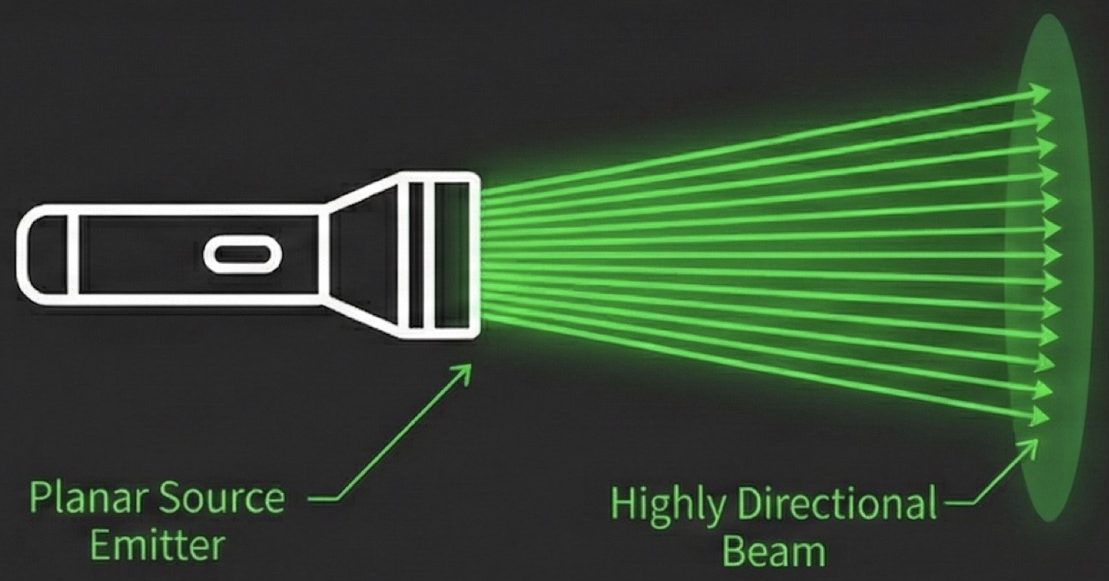
Have you ever imagined a flashlight for sound?
A flashlight handles the same light very differently. It gathers the energy into one direction and illuminates only what you point it at. That is exactly what a directional speaker does. It concentrates sound into a narrow beam as a planar source and sends it out in one direction like a laser. Outside the aimed direction, it is quiet.
"Treating sound like light" is not an exaggeration. But there is a trap hidden in that sentence: audible sound cannot be aimed in the first place. Understanding why is the starting point for this entire technology.
Why ultrasound? A question of wavelength versus aperture
Whether a wave can be gathered into a narrow beam is decided by how many times larger the emitting surface (the aperture) is than the wavelength. If the aperture is far larger than the wavelength, the wave travels straight; if the aperture is comparable to or smaller than the wavelength, the wave bends sharply at the edges — diffracts — and spreads in all directions. A flashlight can collimate light for the same reason: visible light has a wavelength of 0.0005 mm while the lens is tens of millimetres, so the aperture is tens of thousands of wavelengths across.
Run the same calculation for sound and the situation is entirely different. In air at room temperature (20 °C) the speed of sound is about 343 m/s, which gives these wavelengths.
| Frequency | Wavelength | A 30 cm aperture equals | Directivity |
|---|---|---|---|
| 100 Hz (bass) | 3.43 m | 0.09 wavelengths | Effectively omnidirectional |
| 1 kHz (human voice) | 34.3 cm | 0.9 wavelengths | Nearly omnidirectional |
| 20 kHz (hearing limit) | 1.7 cm | 17 wavelengths | Somewhat directional |
| 40 kHz (ultrasound) | 8.6 mm | 35 wavelengths | Narrow beam |
The table makes the point plainly. The sounds we actually want to hear — speech, music — have wavelengths of tens of centimetres to several metres. Beaming them would require a speaker face several metres across. Short of turning an entire wall into a loudspeaker, it cannot be done.
So the idea gets inverted. Instead of aiming audible sound, you load the sound onto ultrasound that can be aimed, and let the air itself bring the sound back. Air does not behave like a perfect spring when the sound pressure is very high. Because of this slight nonlinearity, the audio content riding on the ultrasonic beam is restored on its own along the path the beam travels. Since the ultrasonic beam travels straight, the audible sound born inside it inherits the beam's shape. This is the parametric acoustic array, and we dig into it — equations included — in parts 6 and 7.
Three defining traits — precision, clarity, privacy

1. High directivity
Sound does not leak sideways; it is delivered only inside the sound zone in the aimed direction. That means you can create separate acoustic zones within a single space. Low sideways leakage also means several pieces of content can play in one room without interfering with each other.
2. Clarity at distance
Because the energy travels packed inside a beam rather than spreading, the decay with distance is far gentler than for an ordinary speaker. The 6 dB rule above is substantially relaxed inside the beam. Depending on conditions, clear delivery over tens of metres is achievable.
3. Solving noise pollution, and privacy
Information reaches only the intended person, so bystanders are not disturbed. Seen from the listener's side, it becomes "sound only I can hear" — listening privacy without headphones.
How it differs from an ordinary speaker
| Aspect | Ordinary speaker | Directional speaker |
|---|---|---|
| Source type | Point source — spherical wave | Planar source — beam |
| What is actually emitted | Audible sound (20 Hz–20 kHz) | Ultrasonic carrier (tens of kHz) |
| Where the sound is created | At the diaphragm surface | In the air along the beam |
| Decay with distance | 6 dB per doubling | Far gentler inside the beam |
| Beam angle | Tens of degrees to 180° | A few to tens of degrees |
| Strengths | Wide bandwidth, high fidelity, low cost | Spatial separation, privacy, range |
| Weaknesses | Sound leakage, interference | Weak bass, distortion, air absorption |
How it differs from technologies that look similar
This is not the only route towards the goal of "making sound audible on one side only." There are in fact several neighbouring technologies that are easily confused with it, and marking out the differences clarifies where this one sits.
| Approach | Basic principle | Band that can be aimed | Hardware size | Decisive limitation |
|---|---|---|---|---|
| Parabolic reflector | Reflects and focuses audible sound with a curved surface | Mid and high only | Very large | Long-wavelength bass still cannot be gathered |
| Audible-band speaker array | Forms a beam from phase differences across speakers | Mainly mid and high | Large — aperture scales with wavelength | Aiming bass would need an array metres across |
| Sound masking | Adds sound that covers the noise | Not applicable | Small | Nothing gets quieter; total noise increases |
| Near-field speakers (headrest, neckband) | Placed close to the ear so the level can be low | Full range | Small | Solves it with distance, not aiming — the listener cannot move |
| Ultrasonic parametric | Loaded onto ultrasound; the air restores it | Mid and high (bass weak) | Thin panel | Distortion, air absorption, weak bass |
One thing the table shares across every row: no approach aims bass. There is physically no way to confine a wave metres long with a device the size of a person. Every technology claiming "personalised sound" therefore ends up competing in speech and the mid-to-high range.
Where do they diverge? Reflectors and audible-band arrays buy directivity by enlarging the aperture. Sound masking is concealment rather than aiming, so it is a solution pointing in a different direction. Near-field speakers substitute distance for aiming. Only the ultrasonic parametric approach sidesteps the problem by changing the wavelength itself — putting sound that cannot be aimed onto sound that can. In that respect its approach is fundamentally different.
Sixty years of lineage — it began underwater
This technology was born not in air but in water. In 1963 a theory was published showing that when two strong ultrasonic beams travel in the same direction, the nonlinearity of the medium generates a new wave at the difference of the two frequencies, and that the low-frequency wave born this way inherits the narrow directivity of the original beams. It was a direct solution to a long-standing sonar problem: obtaining a narrow beam while using a low frequency.
In 1965 the relation describing how an amplitude-modulated ultrasonic wave restores the original signal on its own — self-demodulation — was formalised. The result that the demodulated sound is proportional to the second time derivative of the modulation envelope became the starting point for every later signal-processing technique for controlling distortion (parts 12–14).
The move into air came in 1983, when a paper presented a loudspeaker structure that radiates amplitude-modulated ultrasound into air from a transducer array to produce audible sound. It was the experiment that showed the approach actually works in air — a medium with far greater nonlinearity than water, but also far greater absorption. From the late 1980s patents on directional loudspeaker structures began to appear, and in the late 1990s a method of heterodyning ultrasonic carriers to obtain audible sound was formalised in a patent, after which commercial products emerged.
Misconceptions and limits — it is not a cure-all
"Injecting sound into a quiet space" is an appealing description, but physics gives nothing away for free. This technology carries clear costs.
- Air eats ultrasound quickly — atmospheric absorption grows roughly with the square of frequency. Feeding 20 °C and 50 % relative humidity into the international standard formula (ISO 9613-1) gives 0.0003 dB per metre at 100 Hz but about 1.3 dB per metre at 40 kHz — more than four thousand times greater. Over 10 m, 13 dB of the carrier alone disappears, and this is the first wall that sets the working range.
- Directivity collapses on contact with a wall — when the beam strikes a hard surface, that spot behaves like a new source and radiates in all directions. What you aim at matters as much as the aiming itself.
- Distortion is intrinsic to the principle — the mechanism that creates the sound is nonlinear, so distortion is generated as a matter of principle alongside it. Distortion in an ordinary speaker comes from imperfect components; here it comes from the operating principle itself. That is why signal processing is a required component, not an add-on.
- Bass is weak — demodulation efficiency scales with the second derivative of the modulation envelope, which penalises low frequencies. It is ample for voice announcements but heavily constrained for music playback.
- Sound pressure cannot be raised without limit — conversion efficiency is low, so obtaining the desired audible level requires a large ultrasonic level, and ultrasonic exposure itself is subject to guideline limits. Designs always live inside that ceiling.
Five numbers you will keep meeting in this series
Thirteen more articles follow. A handful of values keep coming back through them, and gathering those in one place now keeps you from losing your way later. There is no need to memorise them — it is enough to recognise them when they reappear.
| Value | What it is | Where it comes from | What it decides |
|---|---|---|---|
| 8.6 mm | Wavelength of 40 kHz ultrasound in air | 343 m/s ÷ 40,000 Hz | Beamwidth, element size, array spacing — essentially everything |
| 1.3 dB/m | Air absorption coefficient at 40 kHz | The standard atmospheric absorption formulation (20 °C, 50 % RH) | The ceiling on range |
| −43 dB | Fraction of energy crossing from piezoelectric ceramic into air | The acoustic impedance mismatch between the two media | Conversion efficiency, the need for matching layers |
| 12 dB/oct | The slope lost going down in frequency | Demodulated sound scales with the second derivative of the squared envelope | Why it is weak on music and strong on speech |
| λ/2 | Maximum spacing between array elements | The spatial aliasing condition | Steerable angle, number of elements |
All five point the same way: the performance of this technology is set by wavelength, not by materials or circuits. Because the wavelength is 8.6 mm, array spacing must be 4.3 mm or less, which is why hundreds of elements are needed; and because the wavelength is short, absorption is high and range is confined to metres. Whatever the topic in whatever article, when you get stuck, coming back to the wavelength usually unlocks it.
When this technology is not the answer
When you assess a new approach, the question settled fastest is not "can it be used?" but "should it not be used?" The previous section stated the limits in the language of physics; this one translates that physics into the shapes it takes on site. If any one of the five situations below applies, a directional speaker is usually the wrong choice, and forcing the fit means the problem surfaces only after installation.
| If this is your situation | Why it does not fit | What to use instead |
|---|---|---|
| A wide area must be filled evenly | A beam fills only a narrow region. Covering an area means unit count rises in proportion to that area, and gaps where the sound cuts out remain between beams | Ordinary speakers distributed across the ceiling |
| Bass is the heart of the content | Demodulation efficiency falls steeply toward low frequencies (the 12 dB per octave in the table above). The fundamentals of music and the sense of impact are the first things to go | Ordinary speakers paired with a dedicated low-frequency unit |
| Listeners are constantly moving | The sound disappears the moment they leave the sound zone. For visitors walking through, it becomes an announcement that keeps cutting out | Wearable units placed near the ear, or a configuration that steers the beam to follow the listener |
| A small room with hard surfaces | When the beam bounces off walls, glass or the floor, that spot behaves like a new source and the directivity collapses | Absorptive finishes alongside it, or give up aiming and use ordinary speakers |
| Mass installation where cost and power draw come first | Hundreds of transducers plus modulation and amplification stages make the build heavier than an ordinary speaker producing the same level | Ordinary speakers |
One more case deserves a place on the list: when it is expected to be a device that makes things quiet. This technology cannot reduce noise that already exists. All it does is keep the sound it newly emits from spilling sideways. Making a loud space quiet belongs to absorption, isolation and active noise control; the directional speaker stands on the opposite side — adding sound while letting less of it spread. Miss that distinction and the requirement is misstated from the very beginning.
Read in reverse, the table doubles as a table of good fits. Indoors, within a few metres, voice-centric, and with listeners who mostly stay put — where those four overlap, this technology solves the problem more cleanly than any alternative. The further you drift from the four, the faster the price paid outgrows the benefit, and it is better to work that out early in the review than after the units are on the ceiling.
Where can it be used?
Per-exhibit audio guides in a gallery, directional safety announcements at crossings and platforms, targeted advertising in front of a retail display, personal alerts in an office — the moment sound can be aimed, applications multiply with the number of spaces. Because of the limits above, the best-fitting combination is indoors, medium range, voice-centric. Use cases are covered in detail in part 3.
About this series
"The Science of Directional Speakers" continues in the order below. From the basic physics of sound through ultrasound, nonlinear acoustics, beamforming, transducer hardware and digital signal processing — we follow the full technology stack behind a finished product.
- What is a directional speaker — a flashlight for sound (this article)
- Carrying sound on sound you cannot hear — first steps in the operating principle
- Directional speaker use cases — exhibitions, safety, retail, offices
- What is ultrasound — definitions, types, propagation
- Then: the parametric acoustic array (PAA), beamforming, piezoelectric transducers, Nyquist, modulation, signal processing
This series reworks, in blog form, self-authored lecture material from the author's own study of ultrasonic directional audio. The figures are drawn from that material.
References
- P. J. Westervelt, "Parametric Acoustic Array," JASA 35(4), 535 (1963) : the original paper on parametric array theory — nonlinear interaction generating a difference-frequency wave
- H. O. Berktay, "Possible exploitation of non-linear acoustics in underwater transmitting applications," JSV 2(4), 435 (1965) : the self-demodulation relation — demodulated sound proportional to the second derivative of the modulation envelope
- M. Yoneyama et al., "The audio spotlight: An application of nonlinear interaction of sound waves to a new type of loudspeaker design," JASA 73(5), 1532 (1983) : the first implementation of a parametric loudspeaker in air
- Parametric Acoustic Array and Its Application in Underwater Acoustic Engineering (open-access review) : theory and applications of the parametric array, from its underwater origins
- US 4,823,908 — Directional loudspeaker system : an early directional loudspeaker structure patent
- US 5,889,870 — Acoustic heterodyne device and method : obtaining audible sound by heterodyning ultrasonic carriers
- H. E. Bass et al., "Atmospheric absorption of sound: Further developments," JASA 97(1), 680 (1995) : the absorption-coefficient formulation behind ISO 9613-1 — basis for the 0.0003 dB/m at 100 Hz and ~1.3 dB/m at 40 kHz figures used above
- Sound from ultrasound — Wikipedia : overview of generating audible sound from ultrasound
- Inverse-square law — Wikipedia : basis for the 6 dB per doubling of distance figure
- Diffraction — Wikipedia : why waves spread when the wavelength is large relative to the aperture
- Beamforming — Wikipedia : forming a beam from phase differences across array elements — the audible-band array in the comparison table
- Sound masking — Wikipedia : covering noise by adding sound — the approach contrasted with aiming