Everything we have built over seventeen installments — precise grains, an accurate doping profile, sidewalls close to vertical — can be undone by a single speck of dust. And by a particle too small to see, at that.
Cleaning is the process that appears most often between other processes, and at the same time the most underrated one. As the first installment in the cleaning chapter, this one starts from a fundamental question — what force is actually holding a particle to the surface?
Why Smaller Particles Are More Frightening
Intuitively, bigger dust seems more dangerous. In practice, though, small particles are far harder to remove.
The reason lies in how the forces scale. The forces that pull a particle off (inertia, fluid drag) generally fall with the square or the cube of particle size, while the force holding it to the surface falls only linearly with size. As a result, the smaller the particle gets, the more overwhelmingly dominant the adhesion becomes.
Put in words that stays abstract, so let us lay the exponents out in a table. Writing the particle diameter as d, which power of d each force follows is the key to this entire chapter.
| Force | Direction | Approximate form | Dependence on d |
|---|---|---|---|
| Van der Waals attraction | Holds on | A·d ÷ (12 z²) | Proportional to d (first power) |
| Capillary force | Holds on | 2π·d·γ (perfect wetting assumed) | Proportional to d (first power) |
| Electrical double layer repulsion | Pushes away | Depends on surface potential and ion concentration | Roughly proportional to d |
| Fluid drag (wall shear flow) | Pulls off | ≈ 2.55π·μ·shear rate·d² | Second power of d |
| Gravity and inertia | Pulls off | (π/6)·d³·density·acceleration | Third power of d |
The holding side goes as the first power, the removing side as the second or third. Make the particle ten times smaller and the adhesion drops to one tenth, but the removal force drops to one hundredth or one thousandth. The smaller it gets, the more one-sided the contest becomes.
The patent literature states this quantitatively — a particle under 1 µm in diameter can be held to a surface with a force exceeding 100 dynes, corresponding to more than 10⁹ dyn/cm² per unit area. The same document notes that for particles under 50 µm adhering to a dry surface, the van der Waals force is the dominant one, and that gravity is essentially meaningless for fine particles (US 4,987,286 A).
So the common-sense notion of "just brush it off" does not apply. To remove a particle you first have to know the identity of the force holding it.
The Three Forces That Hold a Particle

① Van der Waals Force — Attraction Born of a Momentary Imbalance
Electrons inside an atom are in constant motion, so at any given instant the electron distribution is skewed to one side. That atom becomes a momentary dipole, and it pushes or pulls on the electron cloud of a neighboring atom, inducing a dipole there too. The attraction that results is the van der Waals force (Van der Waals force).
Between individual atoms it is feeble, but where huge numbers of atoms face each other — as with a particle and a surface — it sums into something substantial. Its characteristics are that it reaches relatively far (on the order of 10 nm) and that it grows stronger the larger the particle and the closer the contact.
The first person to actually compute that summation was H. C. Hamaker, in 1937. He showed that if you integrate the feeble attraction between individual atoms across two whole bodies, the attraction between a sphere and a plate can be expressed with nothing but a single constant carrying the material properties and the geometry. That constant is the Hamaker constant A (Hamaker constant). For a sphere on a plate, the attraction takes this form.
F(van der Waals) ≈ A × d ÷ (12 × z²) — d: particle diameter, z: gap at the contact
What deserves attention here is that z enters the denominator squared. Halve the gap and the force quadruples. The effective gap when atoms are in contact is usually taken as about 0.4 nm, and at that distance even a very small particle is held with considerable force.
② Capillary Force — When Water Becomes Glue
If there is a very thin liquid layer between particle and surface, the story changes. When the liquid's pull on both particle and surface exceeds the cohesion within the liquid itself, the liquid acts as a bridge and holds the particle down. This is the capillary force.
Under complete wetting, the capillary force is approximately 2π × diameter × surface tension. The surface tension of water at 20℃ is about 0.0728 N/m, so for a 1 µm particle that comes to roughly 460 nN. As we will see shortly, this is far larger than the van der Waals force under the same conditions.
There are two reasons this is frightening in practice. First, it is usually larger than the van der Waals force. Second, it grows stronger with time — the longer the contact lasts, the more the liquid settles into a stable configuration. The rule of thumb that "contamination left alone gets harder to remove" turns out to have a physical basis.
This is also why drying is hurried after the rinse in wet cleaning: droplets remaining as the surface dries can press particles down onto it. While the substrate is submerged the capillary force does not exist at all; it is born at the very moment the water recedes and a liquid bridge forms. Why drying, the last step of cleaning, is a technical field in its own right is something we will return to in installment 20.
③ Electrical Double Layer — The One Force on Our Side
If the first two forces are on the side of holding the particle, the electrical double layer is on the side of pushing it away. When the surface and the particle carry the same sign of charge, they repel. It is a strong repulsion acting over short distances.
What matters is that this is a force we can control. The alkaline cleaning we will see in the next installment exploits exactly this principle.
Adhesion in Numbers
Exponents alone do not convey much, so let us put real numbers in. The assumptions are these: a Hamaker constant of 1×10⁻²⁰ J for an oxide-water-oxide system (the order of magnitude commonly quoted for this family), a contact gap of 0.4 nm, water surface tension of 0.0728 N/m, particle density of 2,200 kg/m³, a wall shear rate in the cleaning flow of 10⁵ per second, and water viscosity of 0.001 Pa·s. The results come straight from the expressions in the table above.
| Particle diameter | Van der Waals attraction | Capillary force (if wet) | Fluid drag | Gravity |
|---|---|---|---|---|
| 0.1 µm | 0.52 nN | 46 nN | 0.008 nN | 0.000000011 nN |
| 0.3 µm | 1.6 nN | 137 nN | 0.072 nN | 0.0000003 nN |
| 1 µm | 5.2 nN | 457 nN | 0.80 nN | 0.000011 nN |
| 10 µm | 52 nN | 4,574 nN | 80 nN | 0.011 nN |
There are three ways to read this table.
First, gravity is entirely irrelevant. For a 1 µm particle the van der Waals attraction is about 460,000 times its weight. The patent's remark that gravity is essentially meaningless for fine particles is no exaggeration. Particles do not fall off — not even the ones stuck to a ceiling.
Second, moisture changes the whole game. Under the assumptions above the capillary force is about 88 times the van der Waals force, and since both go as the first power of d, that ratio holds regardless of particle size. A particle you could barely remove dry is held two orders of magnitude harder once moisture remains.
Third, fluid drag alone cannot remove small particles. Under these conditions, the diameter at which drag catches up with van der Waals attraction is about 6.5 µm. Below that, the particle stays put no matter how hard you flow. This is what sets the direction of physical cleaning: not raising the flow rate, but producing a locally far larger force, as with ultrasonic cavitation or droplet impact. That is precisely the subject of installment 20.
One caveat should be explicit: this table is an order-of-magnitude comparison assuming an ideally smooth sphere. Real measurements can run well above or below it depending on surface roughness and contact deformation, and that is also why the patent value quoted earlier exceeds this calculation. Even so, the ordering among the forces and their dependence on diameter hold up robustly.
Stick or Not — DLVO Theory
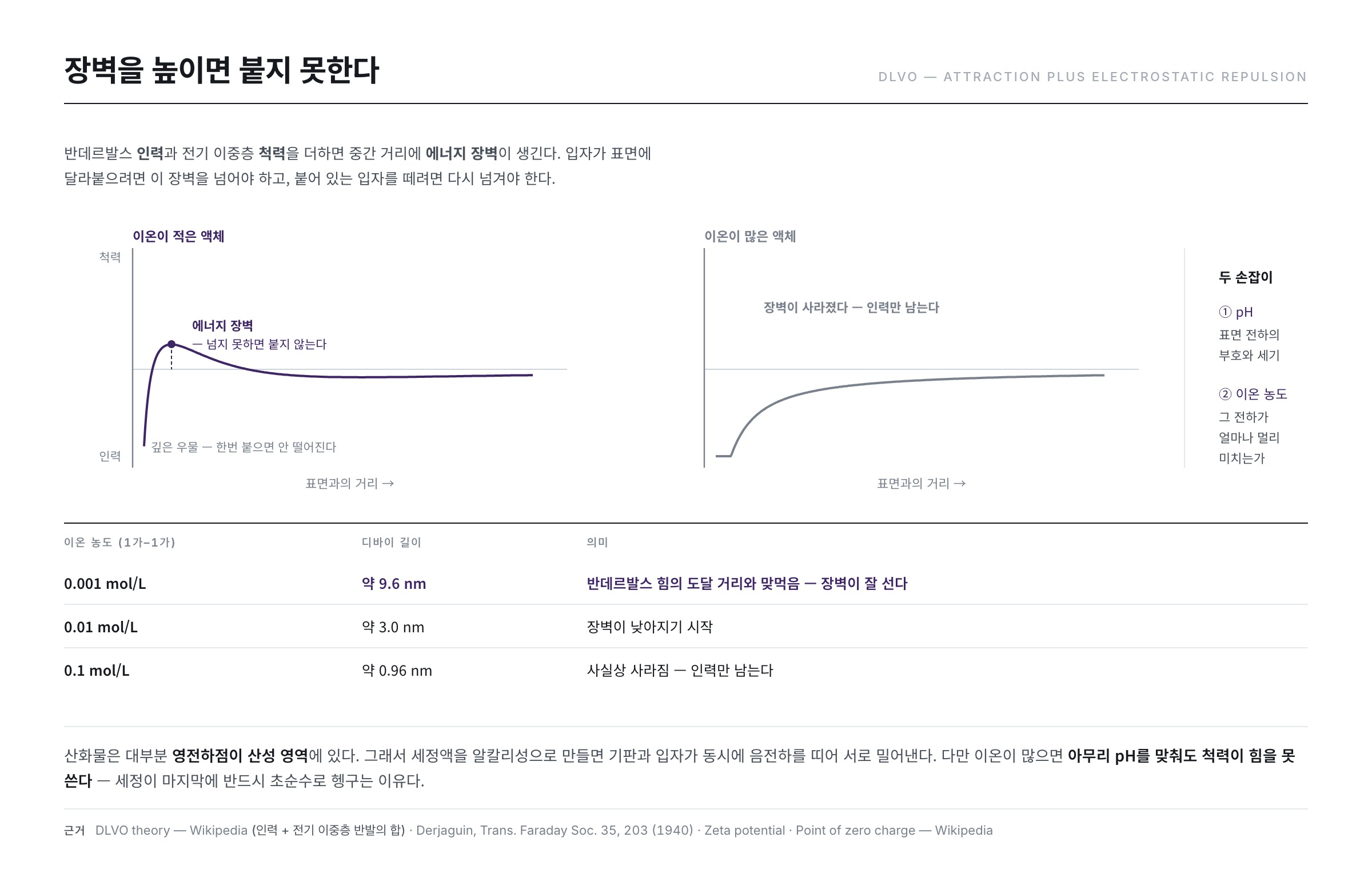
What unifies these forces into a single picture is DLVO theory, a theory of colloid stability established in the 1940s and named after four researchers (Derjaguin, Landau, Verwey, Overbeek).
Tracing the lineage makes it clear why this theory is used in cleaning at all. In 1937 Hamaker computed the attractive term. In 1940 Derjaguin worked out the repulsive term between charged particles and its effect on coagulation rates. In 1941 Derjaguin and Landau combined the two into a stability criterion. Independently, Verwey and Overbeek arrived at the same conclusion and published in 1947–1948. Hence the four surnames became the name of the theory. The starting point was the stability of colloids such as paints, inks and milk, but because the question "will the particle stick to the surface or stay suspended?" has exactly the same structure, it transferred directly to semiconductor and display cleaning.
The core is simple. To quote the Wikipedia definition, DLVO theory "combines the effects of the van der Waals attraction and the electrostatic repulsion due to the double layer of counterions". The total interaction energy is the sum of an attractive and a repulsive term, with van der Waals attraction dominant at short range and double-layer repulsion dominant at long range (DLVO theory).
Adding the two curves produces an interesting shape: an energy barrier appears at intermediate distance. For a particle to stick to the surface it has to clear that barrier, and conversely, to remove a particle that has stuck you have to push it back over the barrier.
This is the strategic point of cleaning chemistry. Raise the barrier and particles cannot reach the surface, staying suspended in the liquid instead. And the barrier height can be tuned with surface charge.
Zeta Potential and pH — The Handle on the Barrier
The measure of how strongly a surface is charged in a liquid is the zeta potential. Wikipedia puts it this way — "the magnitude of the zeta potential indicates the degree of electrostatic repulsion between adjacent, similarly charged particles in a dispersion", and "colloids with high zeta potential are electrically stabilized while colloids with low zeta potentials tend to coagulate" (Zeta potential).
So what changes the zeta potential? pH. Here the concept of the point of zero charge (pzc) enters: the pH at which the net charge on the surface is zero, below which the surface carries a positive charge and above which it carries a negative one (Point of zero charge).
Most oxides, silicon oxide among them, have their point of zero charge in the acidic region. So if you make the cleaning solution alkaline, the substrate surface and the particles become negatively charged at the same time and repel one another. You are using surface chemistry to physically push particles away.
How Far the Repulsion Reaches — The Debye Length
But double-layer repulsion has a second handle. It is not only the sign of the charge that can be tuned but also how far the influence of that charge reaches. The distance in question is the Debye length, and it is set by the ion concentration in the liquid. For water at 25℃ containing only a 1:1 electrolyte, it works out as follows.
| Ion concentration (1:1) | Debye length | What it means |
|---|---|---|
| 0.001 mol/L | about 9.6 nm | Comparable to the reach of van der Waals force — the barrier stands well |
| 0.01 mol/L | about 3.0 nm | The barrier starts to drop |
| 0.1 mol/L | about 0.96 nm | Effectively gone — only attraction remains |
The message is unambiguous. If the cleaning solution is full of ions, no amount of pH adjustment will make the repulsion work, because the ions screen the surface charge from close range. This is why a cleaning sequence always ends with an ultrapure water rinse, and why the quality of that water is managed through resistivity — high resistivity means few ions, and few ions mean a long Debye length, which is what keeps particles from reattaching. We will pick this up again in installment 20 when we look at ultrapure water grades.
Contact Is Not a Point — Deformation, Roughness, Time
Every calculation so far treated the particle as a perfect sphere and the surface as a perfect plane. Reality is otherwise, and the difference governs how hard cleaning turns out to be.
First, the contact gets pressed flat. The van der Waals attraction itself pulls the particle toward the surface, so the contact point deforms slightly and becomes not a point but a small disc-shaped contact area. A wider contact area means more atoms facing each other, which increases the attraction, which presses it further. It is a feedback loop in which sticking makes it stick harder. This is why soft particles (organics, polymers) are harder to remove than hard ones (silica, alumina).
Second, roughness actually helps. If the surface is rough on a nanometre scale, the particle rests on only a few asperities, so the real contact area shrinks and the effective gap widens. Since the van der Waals force goes as the inverse square of the gap, widening the contact gap from 0.4 nm to just 1 nm drops the force to less than a sixth. Hence the paradox that an excessively smooth surface holds particles better.
Third, time intervenes. As a particle sits there, water is squeezed out of the contact and the oxides begin to form hydrogen bonds or siloxane bridges with each other. A particle that was merely resting physically ends up chemically bonded. As work on particle adhesion and removal behavior in RCA cleaning points out, the success of a cleaning step depends not only on the strength of the chemistry but heavily on when the contamination arrived and how long it was left. That is why managing queue time between processes matters as much as changing the cleaning recipe.
The Character of Cleaning as a Process
In summary, cleaning does two jobs.
- Removes what you do not want — particles, organic contamination, metal ions, native oxide.
- Puts the surface into the state you do want — smoothing roughness, making it hydrophilic or hydrophobic, and handing it to the next process.
Sources of contamination are everywhere — equipment, environment (air and water), materials (glass, chemicals), leftovers from the preceding process, and people. So cleaning is not a one-off "wash it when it gets dirty" task but a standing process placed between every other process.
It is worth remembering that those four contaminants are each governed by different physics and chemistry. Particles are a problem of surface forces, as we have seen; organic contamination is a problem of oxidative decomposition; metal ions are a problem of complexation and solubility; native oxide is a problem of selective etching. No single chemistry can face all four, which is why cleaning is always a combination of chemistries applied in sequence. The RCA clean we will see next installment is split into two steps for the same reason.
Common Misconceptions
"Rinse hard enough and it comes off." — As calculated above, fluid drag falls with the square of diameter and never reaches sub-micron particles. Doubling the flow only doubles the shear rate, and the drag you gain is still short of the van der Waals attraction. The role of the rinse is to carry away particles already released, not to release them.
"Particles settle under gravity, so watch the bottom surfaces." — For a 1 µm particle, gravity is about one millionth of the adhesion. Particles stick wherever they meet a surface, top, bottom or side. A cleanroom flows laminar air from ceiling to floor not to settle particles but to organize the flow so that particles shed by people and equipment cannot come back toward the substrate.
"Clean water is enough." — The purity of the water means only that it adds no contamination; that is different from the ability to remove what is already attached. That said, water with a low ion concentration plays an active role by lengthening the Debye length and preventing reattachment. This is why ultrapure water is not a mere "material" but a process parameter.
Next Installment
Now that we know why particles stick, what remains is how to get them off. Installment 19 takes up chemical cleaning — what each of the three agents, hydrofluoric acid, ozone and alkali, is aimed at, and what the RCA clean that has been the standard for over half a century actually is.
References
- Hamaker, "The London—van der Waals attraction between spherical particles", Physica 4, 1058 (1937) : the original paper integrating interatomic attraction over whole bodies and introducing the Hamaker constant
- Derjaguin, "On the repulsive forces between charged colloid particles…", Trans. Faraday Soc. 35, 203 (1940) : repulsion between charged particles and its relation to coagulation rate
- Derjaguin and Landau, "Theory of the stability of strongly charged lyophobic sols…", Prog. Surf. Sci. 43, 30 (1993 reprint) : the 1941 paper combining attractive and repulsive terms into a stability criterion
- Verwey, "Theory of the Stability of Lyophobic Colloids", J. Phys. Colloid Chem. 51, 631 (1947) : the other half of the lineage, reaching the same conclusion independently
- Itano and Kezuka, "Particle Adhesion and Removal on Wafer Surfaces in RCA Cleaning" (1998) : adhesion and reattachment behavior in an actual cleaning process
- US 4,987,286 A — Method and apparatus for removing minute particles from a surface : quantified adhesion for sub-micron particles (above 10⁹ dyn/cm²), van der Waals dominant below 50 µm
- DLVO theory — Wikipedia : the sum of van der Waals attraction and double-layer repulsion, the energy barrier and colloid stability
- Van der Waals force — Wikipedia : attraction from instantaneous dipoles
- Hamaker constant — Wikipedia : the definition of the Hamaker constant and its typical order of magnitude
- Zeta potential — Wikipedia : zeta potential and the degree of electrostatic repulsion
- Point of zero charge — Wikipedia : how the sign of surface charge changes with pH