Part 1 covered what a directional speaker is, and part 2 covered how it works. This article changes the question — so where do you actually use it? The moment sound can be aimed, every space we had given up on because of noise becomes a stage. From exhibition halls to crossings, stores, offices and living rooms, here are the representative applications, organised into four fields.
First, a calibration — how large is a "sound zone" really?
Before looking at applications it helps to calibrate our intuition. "Aiming sound" sounds impressive, but without knowing how sharp the boundary between the quiet region and the audible region actually is, you cannot judge an application.
The beam spreads as a cone, so the diameter at the target is determined by beamwidth and distance alone. As calculated in part 2, a 100 mm array with a 40 kHz carrier gives a −3 dB beamwidth of about 5°. Working out the zone size by distance from that value gives the following.
| Distance | 3° beam | 5° beam | 8° beam | 15° beam |
|---|---|---|---|---|
| 1 m | 0.05 m | 0.09 m | 0.14 m | 0.26 m |
| 2 m | 0.10 m | 0.17 m | 0.28 m | 0.53 m |
| 3 m | 0.16 m | 0.26 m | 0.42 m | 0.79 m |
| 5 m | 0.26 m | 0.44 m | 0.70 m | 1.32 m |
| 10 m | 0.52 m | 0.87 m | 1.40 m | 2.63 m |
Reading the table is simple. A human head is about 0.2 m across and shoulders about 0.45 m. So a unit with a 5° beam creates a zone the size of one person's face at 3 m, and a zone large enough for one standing person at 5 m. It suits places where the user's position is fixed — a kiosk, an exhibit plinth — and by the same token it is hard to apply directly to a large space where people move around freely.
Conversely, if you want a larger zone you can widen the beam (shrink the aperture) or increase the distance, but the probability of leaking to the person next door rises with it. Keeping this table in mind while reading the use cases explains most of the "why does it work there but not here" questions.
1. Culture and exhibitions — an independent sound zone per work
The chronic ailment of an exhibition hall is overlapping sound. The audio guide for the next work bleeds in, and preventing that means renting headphones to every visitor. A directional speaker solves this by creating an independent sound zone only in front of each work.
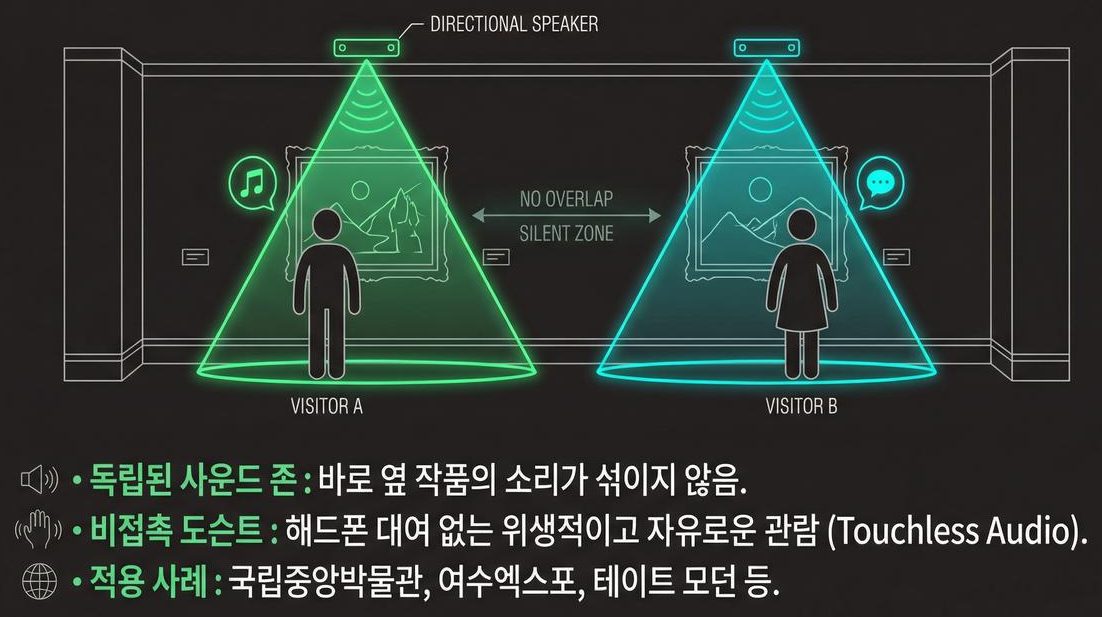
- Independent sound zones — sound from the adjacent work does not mix in. When a visitor takes a step, the sound changes naturally.
- Touchless audio — hygienic, unencumbered viewing with no headphone rental.
- Why it fits so well — visitors stand at a fixed position 1–3 m in front of the work, background noise is quiet at around 45 dB, and the content is spoken commentary rather than music. The weak bass and limited range we saw earlier barely matter in this combination.
Exhibition halls are, however, vulnerable to reflection. If the beam strikes a glass vitrine or a marble floor, that spot becomes a new source and the directivity collapses. Real installations therefore angle the unit towards acoustically absorptive walls or towards the visitor's own body.
2. Safety and public infrastructure — warn only those who need it
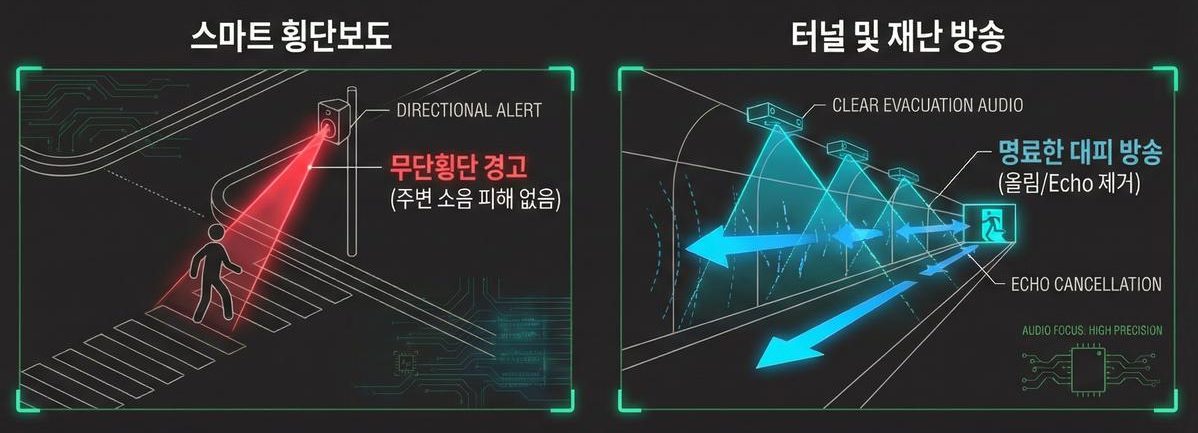
The dilemma of public announcements is that making them audible to everyone creates noise, while turning them down means the message fails to land. Directional speakers tackle that dilemma head-on.
- Smart crossings — a warning is fired only at the pedestrian about to step out. Nearby shops and residents suffer no noise.
- Tunnel and emergency broadcasts — long tunnels are notorious for smearing ordinary announcements through echo. Placing directional beams section by section reduces the energy sent to the walls, suppressing reflections and enabling intelligible evacuation announcements.
The trickiest variable in this field is background noise. For speech to be reliably understood the signal must be sufficiently louder than the background, and a margin of 10 dB or more is customary as a design basis. The required level therefore differs sharply by environment.
| Environment | Approx. background noise | Required level (10 dB margin) | Suitability |
|---|---|---|---|
| Exhibition hall, library | 45 dB | 55 dB | Very well suited |
| Office, retail store | 55 dB | 65 dB | Suited |
| Roadside, station platform | 70 dB | 80 dB | Conditional — needs close placement |
| Tunnel, factory | 80 dB | 90 dB | Difficult — assumes multiple units |
As part 1 explained, the parametric method has low conversion efficiency, so the level cannot be raised without limit. The noisier the environment, the more the answer becomes placing the speaker closer to the target or distributing several units section by section. That is why roadside installations sit directly above the pedestrian, on the signal pole itself.
3. Retail and commerce — acoustic privacy as a service

- Kiosks and cash machines — financial details and order contents are not overheard, protecting privacy. Guidance is audible only inside the "dome of sound" descending over the user's head.
- Digital signage — advertising audio reaches only the customer standing in front of the screen. Marketing without the barker noise filling the whole store.
- Shelf-level promotion — tailored guidance can be played only in front of a particular display.
This field favours directional speakers most because the user's position is fixed. The head of a person standing at a kiosk is almost always in the same place. As the table showed, at 1–2 m the zone narrows to 0.1–0.2 m in diameter, so a design that is inaudible even to the person queuing right behind is genuinely achievable. The same logic explains the top-down mounting: floor reflections are blocked by the user's own body and do not spread sideways.
4. Smart offices and homes — invisible headphones
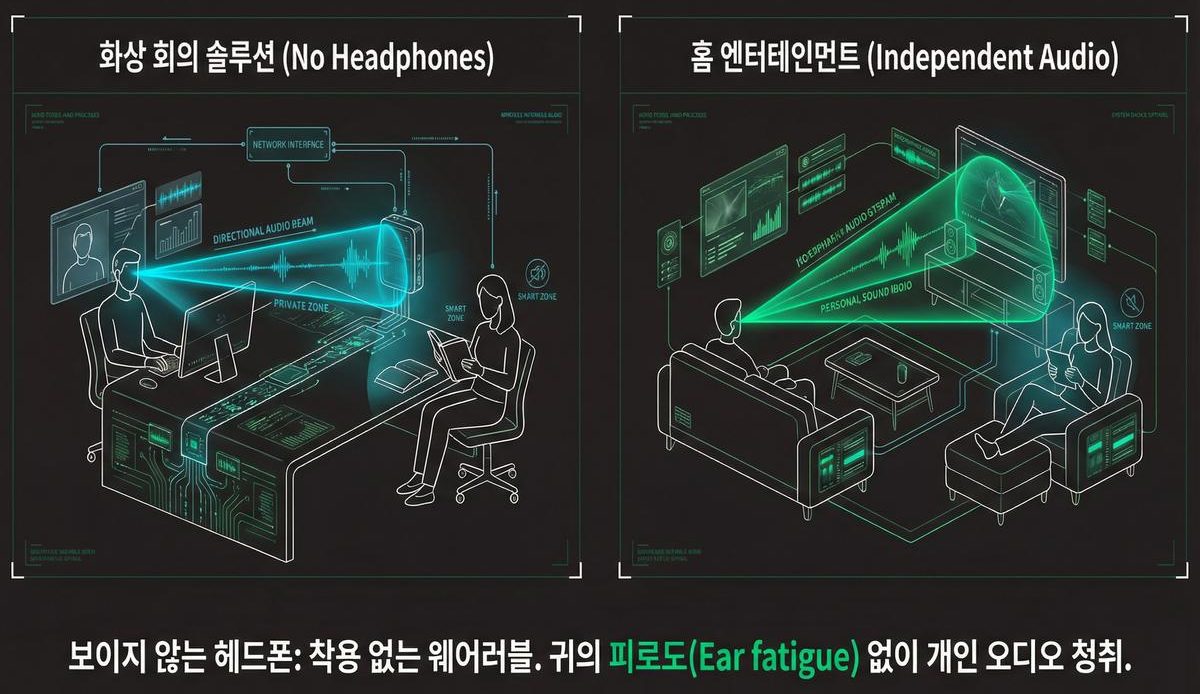
In offices and living rooms the directional speaker becomes invisible headphones — personal audio with nothing worn and without ear fatigue.
- Video conferencing — meeting audio reaches only your seat, with no headset. The colleague beside you can concentrate on their own work.
- Home entertainment — one person watches TV in the living room while another reads. Independent audio in which the TV sound reaches only the viewer on the sofa.
This is also the hardest set of conditions. Music and video soundtracks depend on bass, and as part 2 showed, parametric demodulation cuts the low end at 12 dB per octave. Real implementations therefore go hybrid — the directional unit handles mid and high frequencies while a conventional woofer handles the bass — or restrict themselves to voice content where bass matters less. It is precisely why research into personal sound zones, creating private listening regions with speaker arrays and signal processing, remains active today.
Requirements at a glance, by application
| Application | Target distance | Required level | Content | Biggest risk |
|---|---|---|---|---|
| Exhibition commentary | 1–3 m | 55–60 dB | Speech | Glass and stone reflections |
| Crossing warning | 2–5 m | 80 dB and above | Short alert, speech | Background noise, outdoor temperature and humidity swings |
| Kiosk guidance | 0.5–1.5 m | 60–65 dB | Speech | Close-range carrier exposure |
| Office personal audio | 0.5–1 m | 60 dB | Speech, calls | User movement |
| Home entertainment | 2–4 m | 65–75 dB | Music, video | Weak bass, distortion |
Why installations commonly fail
However good the technology, a misjudged installation erases the benefit. Four failure modes recur in the field.
- Aiming at a reflective surface — when the beam meets glass, tile or sheet metal, that spot becomes a new source and fills the room. You pay for directivity and then throw it away.
- Over-trusting the range — catalogue maximum ranges assume a quiet interior. Outdoors, not only does background noise rise, but the air absorption coefficient itself shifts with temperature and humidity.
- Misjudging the content — putting bass-dependent music through a design intended for speech only increases distortion as you raise the volume.
- Mounting too close — the carrier is strongest immediately in front of the unit. Layouts that place a person's head very near the hardware should be avoided.
After the installation — problems that appear in operation
The failure modes above all belong to the moment of installation. What causes more trouble in the field, though, is the other kind: things that worked at first and degrade slowly. A unit that scored full marks at handover becoming the subject of complaints six months later is not rare. There are broadly four causes.
The season changes the volume
How fast the air eats ultrasound depends on temperature and humidity. At 40 kHz, absorption does not rise monotonically with humidity; it traces a hill that peaks near 40–50 % relative humidity and eases off again above it. Feeding representative operating conditions into the international standard formula gives the following.
| Condition | Temperature and humidity | Absorption at 40 kHz | Carrier loss over 5 m | Versus the reference |
|---|---|---|---|---|
| Indoors, spring or autumn (reference) | 20 °C, 50 % | 1.32 dB/m | 6.6 dB | — |
| Indoors, winter heating | 22 °C, 25 % | 1.05 dB/m | 5.3 dB | 1.3 dB in your favour |
| Indoors, summer cooling | 26 °C, 60 % | 1.30 dB/m | 6.5 dB | Essentially unchanged |
| Outdoors, summer | 30 °C, 80 % | 1.02 dB/m | 5.1 dB | 1.5 dB in your favour |
| Outdoors, winter | 0 °C, 60 % | 0.51 dB/m | 2.6 dB | 4.0 dB in your favour |
In a climate-controlled interior the swing is around 1 dB and can generally be ignored. Outdoors is the problem. In winter the carrier is absorbed far less, so the same settings produce more sound — and there is a multiplier on top of that. In the self-demodulation relation from part 2 the recovered audible pressure follows the square of the carrier pressure, so a 4 dB difference in the carrier shows up as roughly twice that in the audible sound. This is why an outdoor unit whose volume was fixed in summer sounds conspicuously loud in winter, and why the gain should either be corrected against temperature and humidity or the margin set from the worst case.
The radiating face gets dirty and the elements age
When dust and an oily film build up on the radiating face of an ultrasonic transducer, the mass of the vibrating part increases, so the resonant frequency drops and the output falls. Outdoors, or near a kitchen, where fouling is quick, that alone can change the perceived level within a few months. Cleaning should be dry as a rule; solvents or water working into the gaps between elements are hard to recover from. Ageing or failure of individual elements pushes in the same direction — once the phase alignment of the array is disturbed, the beam blunts and the side lobes that spill outward grow.
The space quietly changes
The aiming line set at installation assumes the furniture layout of that day. Move a display stand, put up a sign, add a glass partition, and a new reflecting surface appears where the beam used to pass. An angle chosen to land on people's bodies may be pointing at a glass case six months later. The content changes just as readily. Where the design assumed voice announcements, adding background music or sound effects raises distortion and exceeds the band limit without anyone touching the hardware.
What these three share is that the fault arrives as "quietly getting worse", not "no sound". A check performed by listening from the intended position will not catch it. Operational inspection therefore has to ask not "can it be heard in place?" but "can it be heard out of place?" Logging the level at one or two points outside the zone and re-measuring the same points periodically is the cheapest way to keep this technology working for years.
Before mounting it in a public place — the question of ultrasonic exposure
The moment a directional speaker goes into a crowded place, a question separate from the specifications follows it: is it fine to be continuously exposed to sound you cannot hear?
The question is awkward for three reasons. First, sensitivity near the upper hearing limit varies greatly between individuals; components near 20 kHz inaudible to most adults may be audible to children and young adults. Second, national exposure guidance for airborne ultrasound was largely written with adult workers in industrial settings in mind, not public spaces traversed by an unselected population. Third, reports of headache, tinnitus and discomfort exist but causality is unestablished, and the matter remains debated within the field.
Practice is therefore conservative. Mounting height and angle are chosen so that heads do not dwell directly in front of the unit, where the carrier level is highest; the carrier is raised only as far as the required audible level demands; and extra margin is allowed where children's paths cross. Because the parametric method converts inefficiently, "a little louder" means "much more ultrasound" — so level design and safety design are not separable.
Five things to settle before deploying
Compressing the tables above into a single decision procedure gives the following. Answer all five and it usually works; leave one blank and it usually fails.
- Where does the listener stand? — a fixed position is ideal; if they move, you need a wider beam or steering. If the position is unknown, this technology is not the answer.
- How many dB is the background noise there? — add 10 dB to get the required level, and that value sets the working range.
- What does the beam hit after passing the person? — glass, tile or metal turns that spot into a new source and the directivity collapses. Aim at an absorptive surface, or at the listener's own body.
- Is the content speech or music? — speech fits well; music needs a separate design to compensate the bass.
- How far is a person's head from the unit? — the carrier is strongest immediately in front. Avoid layouts that place people too close.
What runs through all five is the order of operations: settle the space first, then choose the equipment. Buying a good unit and then wondering where to mount it tends to land on one of the four failure modes above.
Outlook — an age of talking to things through sound

The end point of this trend is an age of humans communicating with objects through sound. The Sound of Things, in which every object conveys information acoustically; the spread of touchless interfaces for hygiene and convenience; and the arrival of ultra-miniature ultrasonic transducer arrays built with semiconductor processes — directional audio is more accurately read not as one type of speaker but as a shift in interface. Just as screens monopolise our gaze, sound too can be personalised: that is the real implication of this technology.
That is the broad map of applications. From the next article we go inside the technology. The first gateway is the raw material of all of this — ultrasound: definitions, types and propagation, step by step.
About this series
"The Science of Directional Speakers" continues in the order below.
- What is a directional speaker — a flashlight for sound
- Carrying sound on sound you cannot hear — first steps in the operating principle
- Directional speaker use cases — exhibitions, safety, retail, offices (this article)
- What is ultrasound — definitions, types, propagation
- Then: the parametric acoustic array (PAA), beamforming, piezoelectric transducers, Nyquist, modulation, signal processing
This series reworks, in blog form, self-authored lecture material from the author's own study of ultrasonic directional audio. The figures are drawn from that material.
References
- P. Kadlec, "Directional Loudspeaker Using a Parametric Array," Acta Polytechnica 46 (2006) : construction and measured directivity of a parametric array loudspeaker
- M. Yoneyama et al., "The audio spotlight: An application of nonlinear interaction of sound waves to a new type of loudspeaker design," JASA 73(5), 1532 (1983) : the first implementation in air, with directivity measurements
- "Constrained optimization of acoustic contrast for personal sound zones," Applied Acoustics 242, 111058 (2026) : recent work on creating private listening regions within one space
- R. Plomp, "A Signal-to-Noise Ratio Model for the Speech-Reception Threshold," J. Speech Hear. Res. 29(2), 146 (1986) : how signal margin over background noise affects speech reception — basis for the 10 dB margin used above
- "Piezoelectric micromachined ultrasonic transducer array for micro audio directional speaker," IEEE ICMA (2013), 450 : ultra-miniature ultrasonic arrays built with semiconductor processes
- H. E. Bass et al., "Atmospheric absorption of sound: Further developments," JASA 97(1), 680 (1995) : the air absorption coefficients used for outdoor range estimates, including temperature and humidity dependence
- T. G. Leighton, "Are some people suffering as a result of increasing mass exposure of the public to ultrasound in air?," Proc. R. Soc. A 472, 20150624 (2016) : effects of public exposure to airborne ultrasound and the limits of existing guidance
- "Public Exposure to Airborne Ultrasound and Very High Frequency Sound," Acoustics Today 16(3), 17 (2020) : survey of public exposure to ultrasound and very high frequency sound
- "Exposure to High-Frequency Sound and Ultrasound in Public Places," Acoustics 1(4), 816 (2019) : field measurements in public spaces and the problem of individual variation
- US 5,889,870 — Acoustic heterodyne device and method : obtaining audible sound from an ultrasonic carrier
- US 4,823,908 — Directional loudspeaker system : an early directional loudspeaker structure patent
- Sound from ultrasound — Wikipedia : overview of generating audible sound from ultrasound
- Speech intelligibility — Wikipedia : factors governing speech intelligibility in noise